

Shockwave Therapy in Encinitas CA
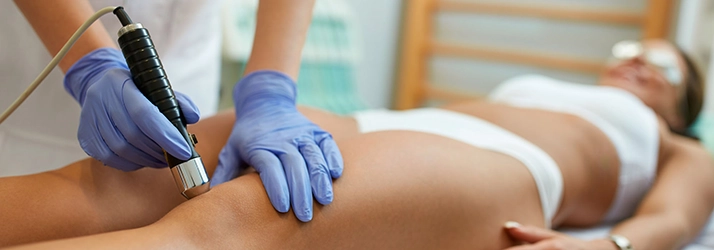
If you've had a pain problem for longer than three months, you've probably already tried the standard list. Rest. Ice. Stretching. Maybe a cortisone shot that helped for six weeks and then wore off. The frustrating part isn't the pain itself. It's that the tissue seems to have stopped trying to heal.
That's exactly the problem focused shockwave therapy was built to solve — and it applies to a lot more than tendons. Muscle, joint, bone, and spinal conditions all respond to the same underlying biology.
At Catalyst Health in Cardiff-by-the-Sea, we use focused shockwave in Encinitas CA as part of a broader sports chiropractic and soft tissue approach for athletes and active adults across North County San Diego. This article explains how it actually works, what it treats, and why the distinction between focused and radial shockwave matters more than most clinics let on.
What Focused Shockwave Therapy Actually Is in Encinitas CA
Shockwave therapy has nothing to do with electricity. The name is misleading. A shockwave is an acoustic pressure wave — a sound-based energy pulse with an extremely fast rise time, meaning it goes from ambient pressure to very high pressure in a matter of nanoseconds.
The technology came out of urology. Lithotripsy used focused shockwaves to break up kidney stones without surgery. Clinicians then noticed something unexpected on follow-up imaging: bone in the path of the waves was showing signs of hypertrophy, which suggested the energy was doing something osteogenic. That observation is the origin of everything that followed in musculoskeletal medicine.
A focused shockwave device generates that pulse inside the applicator head — electromagnetically, electrohydraulically, or piezoelectrically — and then converges it to a precise focal point beneath the skin. The energy is low at the surface and highest at the target.
How It Stimulates Healing
Chronic musculoskeletal pain is usually not primarily an inflammation problem. More often it's a failed healing response. The tissue is degenerated, poorly vascularized, and stuck in a state where the normal repair cascade never completed. In muscle, it can be persistent taut bands and sensitized trigger points. In joints, it can be bone marrow changes under the cartilage surface. In the low back, it's often a mix of muscular, fascial, and joint-level irritation that never fully resolved. Anti-inflammatories don't fix any of that, which is a large part of why they so often disappoint.
Focused shockwave works through a few overlapping mechanisms:
Mechanotransduction. Cells respond to mechanical signals. The rapid pressure change deforms cell membranes and triggers biochemical signaling cascades that restart repair activity in tissue that had gone quiet.
Cavitation and neovascularization. Behind the compressive pulse is a brief negative-pressure phase that forms and collapses microscopic bubbles in tissue fluid. This microtrauma is controlled and intentional. It upregulates growth factors involved in building new blood vessels — most notably VEGF and nitric oxide synthase. New capillaries mean tissue finally gets the blood supply it needs to remodel.
Pain modulation. Shockwave appears to reduce concentrations of the neurotransmitters that carry pain signals from the periphery, including substance P and CGRP, and to desensitize local nociceptors. This is why many patients report meaningful relief in the first week or two, well before structural remodeling has occurred. It's also why it works well on muscular and myofascial pain, where the problem is as much about a sensitized nervous system as it is about tissue damage.
Releasing muscle tone and trigger points. Focused energy delivered into a taut band or an active trigger point reduces local pain and referred pain patterns, which is why it pairs so naturally with manual soft tissue work.
Breaking down calcification. In calcific tendinopathy, focused energy can fragment the mineral deposits so the body can resorb them.
The important framing: shockwave doesn't mask the problem. It provokes a biological response and then the tissue does the work over the following weeks. That's also why results tend to keep improving for two to three months after the last session.
Conditions We Treat With Focused Shockwave in Cardiff
Clinical indications span upper and lower extremity tendinopathies, frozen shoulder, carpal tunnel syndrome, greater trochanteric pain syndrome, medial tibial stress syndrome, plantar fasciopathy, delayed bone healing, avascular necrosis of the femoral head, osteoarthritis, and low back pain. Here's how that breaks down in practice.
Spine and low back
- Chronic low back pain, including pain driven by muscular guarding, fascial restriction, and deep paraspinal trigger points
- Gluteal and deep hip pain that refers into the back or down the leg
- Sacroiliac and posterior pelvic pain
- Chronic neck pain and upper trapezius myofascial pain
Low back pain and trapezius myofascial syndrome are among the conditions with documented evidence support in the shockwave literature. Deep paraspinal and gluteal musculature is exactly the kind of target where focused energy earns its keep, because those structures sit well below what a surface-level device can reach.
Muscle and myofascial
- Myofascial pain syndrome and active trigger points
- Chronic muscle tightness and guarding that returns within days of manual treatment
- Post-injury scar tissue and fibrotic restriction from old strains
- Muscle strains that haven't fully resolved, particularly hamstring and calf
- Shin splints / medial tibial stress syndrome
Joints
- Knee osteoarthritis, including cases with bone marrow lesions under the joint surface
- Hip osteoarthritis and greater trochanteric pain syndrome
- Frozen shoulder / adhesive capsulitis
- Osteitis pubis
- Bursitis around the hip, shoulder, and knee
Pain, function, and imaging findings have improved across studies of shockwave for bone marrow edema, with that effect holding across several different pathologies including femoral head osteonecrosis, knee osteoarthritis-related edema, Kienböck's disease, and osteitis pubis.
Tendon and fascia
- Plantar fasciitis and heel pain — including cases that have persisted through orthotics, night splints, and injections
- Achilles tendinopathy — both mid-portion and insertional
- Patellar tendinopathy (jumper's knee)
- Rotator cuff tendinopathy and calcific tendinitis of the shoulder
- Lateral and medial epicondylitis (tennis and golfer's elbow)
- Proximal hamstring tendinopathy — a deep target where focused energy has a real advantage
Bone
- Bone stress injuries in runners — promising, though published evidence here is still limited to case series rather than large randomized trials
- Delayed union and non-union fractures
- Avascular necrosis of the femoral head
Nerve-related
- Carpal tunnel syndrome
Best candidates are people with symptoms lasting more than six weeks who have plateaued with conservative care. Shockwave is generally recommended for chronic or resistant musculoskeletal cases where other conservative approaches haven't produced results.
Focused vs. Radial Shockwave: The Difference Most Clinics Don't Explain
This is the part worth understanding before you book anywhere, because the two technologies get marketed under the same name and they are not the same thing.
Radial shockwave (more accurately called radial pressure wave therapy) generates acoustic waves by using compressed air to drive a projectile into a transmitter in the handpiece, producing waves that spread outward in a broad, divergent pattern. Energy is greatest at the tip of the applicator where it contacts the skin and weakens as it travels, giving an effective treatment depth of roughly 3 to 4 cm. Technically, the radial wave doesn't travel fast enough to meet the physics definition of a shockwave at all.
Focused shockwave generates a true shockwave and converges it at a selectable depth. Penetration reaches approximately 10 to 12 cm, with substantially higher energy flux density concentrated in a localized treatment zone. Because the energy converges below the surface, the skin and superficial tissue at the applicator site experience comparatively little impact.
What This Means Practically
| Radial | Focused | |
|---|---|---|
| Wave Pattern | Divergent, spreads outward | Convergent, meets at a focal point |
| Peak Energy | At the skin surface | At the target depth |
| Effective Depth | ~3–4 cm | Up to ~12 cm, adjustable |
| Precision | Broad treatment field | Millimeter-level targeting |
| Best Suited For | Large, superficial areas | Deep, specific structures; bone; joints; chronic focal pain |
Neither one is universally better. Radial is genuinely useful for broad myofascial work over large superficial areas, and it covers ground quickly. But if the problem is deep — a proximal hamstring tendon, the gluteal complex, the deep paraspinals of the low back, a femoral head, the subchondral bone of the knee — radial energy is attenuating before it gets there. You can't treat what you can't reach.
Focused shockwave also lets us work with diagnostic precision. We can map the symptomatic tissue, set the focal depth to match, and deliver energy exactly where the pathology lives.
What a Session Is Like
A typical treatment runs 10 to 15 minutes. You'll feel a firm tapping or thudding sensation at the target. Focused shockwave at therapeutic energy levels is generally tolerable but not entirely comfortable — the sensation is usually described as deep and percussive. We titrate the energy up over the course of a session rather than starting at maximum.
No anesthetic is used, and none is needed. Anesthetic would actually work against us, because patient feedback on where the pain reproduces is part of how we locate the right target.
Most protocols run three to six sessions spaced about a week apart. Some soreness for 24 to 48 hours afterward is normal and expected. We generally ask you to avoid anti-inflammatories during the treatment course, since blunting the inflammatory response works directly against the mechanism we're trying to trigger.
Every patient is screened beforehand to confirm shockwave is appropriate for their situation and history.
At Catalyst Health, shockwave is rarely used in isolation. It's paired with SFMA-based movement assessment, Active Release Technique, and a loading program, because stimulating tissue to remodel without then loading it correctly leaves most of the benefit on the table.
Book a Free Shockwave Demo Session in Cardiff-by-the-Sea
The easiest way to know whether focused shockwave is right for your pain is to feel it and talk it through with someone who can assess the underlying problem.
We offer a complimentary demo session at our Cardiff, CA office. You'll get a brief assessment of the area, a hands-on trial of focused shockwave on the target tissue, and a straight answer about whether this is likely to help you — including if the answer is no.
How Successful Is Shockwave Therapy?
Is Shockwave Therapy Covered By Insurance?
Are There Any Contraindications With Shockwave Therapy?
How Many Sessions Do I Need?
When Will I See Improvement From Shockwave Therapy?

OFFICE HOURS
Monday
8:00am - 6:00pm
Tuesday
8:00am - 7:00pm
Wednesday
8:00am - 6:00pm
Thursday
8:00am - 7:00pm
Friday
8:00am - 4:30pm
Saturday
By Appointment Only

Catalyst Health
230 Birmingham Dr
Cardiff, CA 92007